
How Scale Buildup Clogs Tankless Water Heater Components in Texas Homes
How scale buildup clogs tankless water heater components is one of the most common — and most overlooked — plumbing problems Houston homeowners face. Hard water minerals like calcium and magnesium dissolve harmlessly in cold water. But the moment that water hits the intense heat inside your tankless unit, those minerals crystallize and stick to every internal surface they touch.
Here’s a quick breakdown of how it happens:
- Heat exchanger — Narrow flow channels collect mineral deposits first, restricting water flow and forcing your unit to work harder
- Inlet filter screen — Scale particles accumulate and block incoming water before it even reaches the heating coils
- Flow sensor — Mineral crust interferes with accurate flow readings, causing erratic temperature swings
- Internal pipes and fittings — Gradual buildup narrows the internal diameter, reducing your gallons-per-minute output
- Pressure relief valve — Scale can coat the valve seat, preventing it from seating or opening properly
The result? Higher energy bills, lukewarm showers, strange noises, error codes on your display, and a unit that wears out years ahead of schedule. With roughly 85% of American homes dealing with hard water — and Houston’s water hardness often pushing well above 7 grains per gallon — this is not a minor inconvenience. It’s a slow, silent system failure happening right now inside your water heater.
Think of it like the crusty deposits you see forming on a showerhead or the inside of a coffee maker. The same process is happening inside your tankless unit, except you can’t see it — and the consequences are far more expensive.
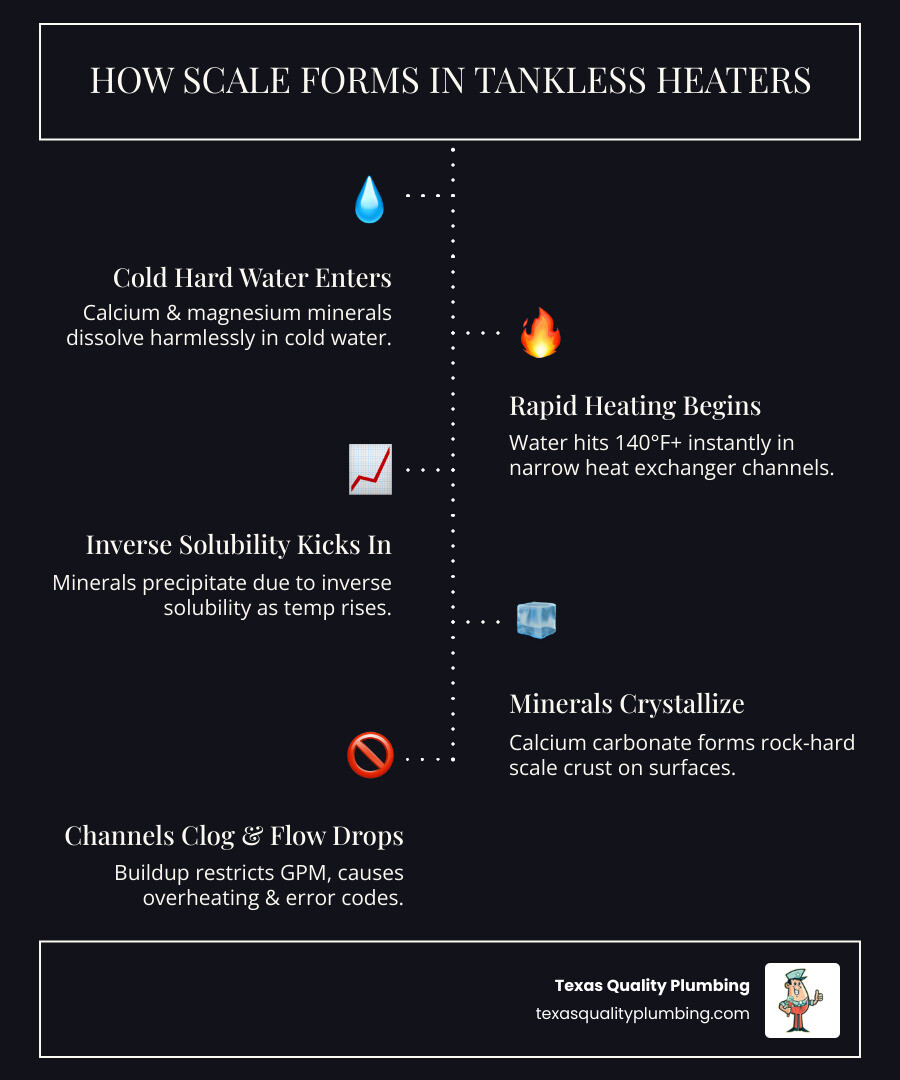
In May 2026, as we look at the water quality across Greater Houston—from the busy streets of Cypress to the quiet neighborhoods of Friendswood—the challenge remains the same: hard water. Scale, or limescale, is primarily composed of calcium carbonate. When hard water is heated, a chemical reaction occurs. Unlike most substances that become more soluble as temperatures rise, calcium and magnesium minerals exhibit “inverse solubility.” This means they precipitate out of the water more rapidly as it gets hotter.
As these minerals solidify, they create a stubborn, rock-like crust. In a tankless system, this process is accelerated because these units are designed to transfer an immense amount of heat into water almost instantly. This rapid temperature spike causes minerals to “snow” out of the water and bake onto the internal surfaces. Over time, these Scaling Issues Tankless Water Heaters can lead to total system failure if left unaddressed.
Why the Heat Exchanger is the First Component Clogged by Scale
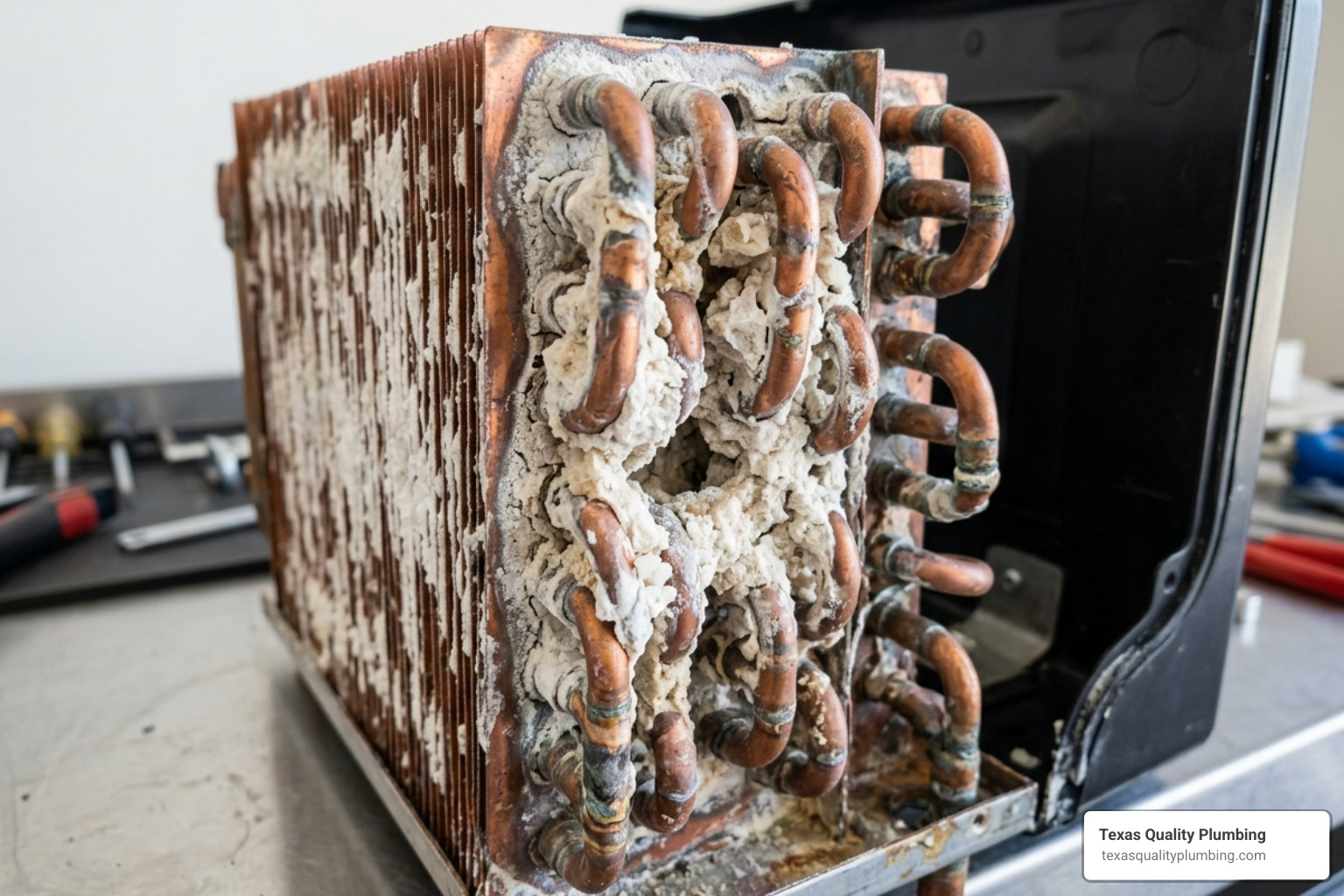
The heat exchanger is the heart of your tankless water heater. It consists of a series of narrow copper or stainless steel coils where the actual heat transfer happens. Because these pathways are so tight—designed that way to maximize efficiency—they are incredibly vulnerable to clogging.
Even a tiny amount of buildup, as thin as 1/8 of an inch, acts as a powerful thermal insulator. In the plumbing world, we often compare this to trying to boil a pot of water through a layer of stone. The scale has a thermal conductivity significantly lower than the metal of the heat exchanger. This forces the burner to run hotter and longer to reach your desired water temperature, leading to Tankless Water Heater Scaling Problems like localized overheating and metal fatigue.
How Scale Buildup Clogs Tankless Water Heater Components and Reduces Flow
As the mineral layers thicken, the internal diameter of the pipes and heat exchanger coils begins to shrink. This is a physical blockage that directly impacts your home’s water pressure. You might notice that while your cold water pressure is fine, your hot water has dwindled to a frustrating trickle.
When the Gallons Per Minute (GPM) rate drops, the unit may struggle to even “fire up.” Tankless heaters require a minimum flow rate to activate the burners. If scale has narrowed the passages enough, the flow sensor won’t detect enough movement to turn the system on, leaving you with nothing but cold water. These are among the most Common Issues Tankless Water Heaters face in high-mineral areas like Sugar Land and Pearland.
Recognizing the Signs of Mineral Clogging in Your Houston Plumbing
Identifying a clog early can save you from a “midnight meltdown” where your system simply quits. One of the most famous symptoms is the “cold water sandwich.” This happens when scale interferes with the internal sensors, causing the unit to cycle on and off. You’ll get a burst of hot water, followed by a sudden chill, then hot water again.
If you are experiencing these fluctuations, it is often a sign that When Hard Water Requires Hydro Jetting or a professional chemical descale is necessary to clear the internal lines of your home’s plumbing system.
Audible Symptoms of Internal Component Clogging
Your water heater will often try to tell you it’s struggling. Have you heard popping, hissing, or rumbling sounds coming from the unit? These aren’t ghosts; they are the sounds of steam bubbles.
When scale coats the heat exchanger, water can get trapped in small pockets underneath the mineral layer. This trapped water overheats and turns to steam, which then “pops” as it escapes back into the cooler water stream. This is a major red flag found in our Tankless Water Heater Maintenance Guide and indicates that the unit is under extreme thermal stress.
How Scale Buildup Clogs Tankless Water Heater Components and Voids Warranties
Many homeowners don’t realize that regular maintenance isn’t just a recommendation—it’s often a legal requirement for your warranty. Manufacturers like Rinnai, Navien, and Rheem specifically state that damage caused by scale is not a manufacturing defect.
When a unit displays an E3 (overheating) or LF (low flow) error code, the first thing a technician will look for is mineral buildup. If you cannot provide records of professional descaling, you might find yourself paying for a very expensive heat exchanger replacement out of pocket. Regular servicing ensures your system stays within the manufacturer’s operational “sweet spot.”
The Long-Term Impact of Neglecting Scale Maintenance
The math behind scale is sobering. Research shows that just 1/4 inch of scale buildup can reduce heating efficiency by 25% to 40%. For the average Houston household, this efficiency loss can result in hundreds of dollars in wasted energy costs every single year.
| Water Hardness Level | Expected Lifespan (No Maintenance) | Expected Lifespan (Maintained) |
|---|---|---|
| Soft Water (0-3 GPG) | 15-20 Years | 20+ Years |
| Hard Water (7-10 GPG) | 8-10 Years | 15-20 Years |
| Very Hard Water (15+ GPG) | 5-7 Years | 12-15 Years |
As shown, ignoring how scale buildup clogs tankless water heater components can literally cut the life of your appliance in half.
Why 85% of American Homes Face Scaling Risks
Hard water is the norm, not the exception. According to USGS data, the vast majority of the United States deals with some level of mineral-rich water. In the Houston area, we frequently see water hardness levels exceeding 10 to 15 grains per gallon (GPG).
Without a plan to manage these minerals, your tankless unit is essentially acting as a filter, catching all those minerals until it can no longer function. This is why Water Softeners Improve Water Quality so significantly—they stop the problem at the source before it ever enters your heater.
Effective Solutions for Clearing and Preventing Scale Clogs
If your unit is already showing signs of clogging, a professional flush is the only way to restore performance. This process involves circulating a food-grade acidic solution through the unit for 60 to 90 minutes. This acid reacts with the calcium carbonate, dissolving the “rock” back into a liquid state so it can be flushed out of the system.
Preventing Future Clogs with Water Treatment Systems
The best way to deal with a clog is to prevent it from forming in the first place. We often recommend two primary methods for our customers in areas like The Woodlands and Kingwood:
- Water Softeners: These systems use ion exchange to replace calcium and magnesium with sodium or potassium ions. This effectively “softens” the water, ensuring that Water Softener Improves Household Water by removing the scale-forming minerals entirely.
- Scale Inhibitors: These are specialized cartridges installed on the cold water inlet of the heater. They release polyphosphates that coat the minerals, preventing them from sticking to the heat exchanger even when heated.
Essential Descaling Tools
If you are a DIY-inclined homeowner, you will need a specific kit to perform a flush. However, we always recommend professional service to ensure no internal gaskets are damaged and the system is properly neutralized afterward. A standard setup includes:
- A 5-gallon bucket
- Two high-pressure washing machine hoses
- A submersible utility pump (rated for 1/6 HP or higher)
- 4 gallons of undiluted white distilled vinegar or a commercial citric acid descaler
Frequently Asked Questions about Tankless Scaling
Can I use CLR to descale my tankless water heater?
We strongly advise against using CLR or other harsh “big box” store chemicals. These products can be far too aggressive for the sensitive copper heat exchangers found in most tankless units. They can also degrade rubber seals and gaskets inside the unit, leading to internal leaks. Stick to food-grade white vinegar or manufacturer-approved citric acid solutions.
How often should I descale my unit in Houston?
In the Greater Houston area, a baseline of once every 12 months is standard. However, if your water test shows hardness above 15 GPG, or if you have a high-occupancy household with heavy hot water usage, we recommend moving to a 6-month maintenance interval.
What happens if I never descale my tankless heater?
Eventually, the heat exchanger will develop “hot spots” where the metal becomes so stressed it cracks. Once the heat exchanger is breached, the unit is usually a total loss. Furthermore, heavy scaling can lead to carbon monoxide risks if the blockage interferes with the proper venting of combustion gases.
Conclusion
Your tankless water heater is a high-performance machine, but it isn’t “set it and forget it.” Understanding how scale buildup clogs tankless water heater components is the first step in protecting your investment and ensuring your family always has a hot shower ready.
At Texas Quality Plumbing, we’ve spent years helping homeowners in Houston, Pasadena, Humble, and throughout the surrounding communities keep their water systems running at peak efficiency. Whether you need a professional descaling flush, a water softener installation, or a comprehensive plumbing inspection, our licensed team is ready to help.
Don’t wait for an error code to ruin your morning. Schedule Expert Tankless Water Heater Service with us today and keep the silent clog at bay!