

Why Your Faucet Won’t Stop Dripping — and What It’s Costing You
Why your faucet drips and what it means for your plumbing comes down to a handful of common causes — and the damage they can do goes well beyond an annoying sound at 2 a.m.
Here’s a quick breakdown:
- Worn washers or seals — the most common cause; friction breaks them down over time
- Damaged O-rings — cause leaks near the handle
- Corroded valve seats — hard water deposits create gaps that let water through
- Faulty cartridges — common in single-handle faucets; affect both flow and temperature
- High water pressure — pressure above 80 psi forces water past seals, even new ones
- Loose or broken internal parts — handles, packing nuts, and stems wear out with use
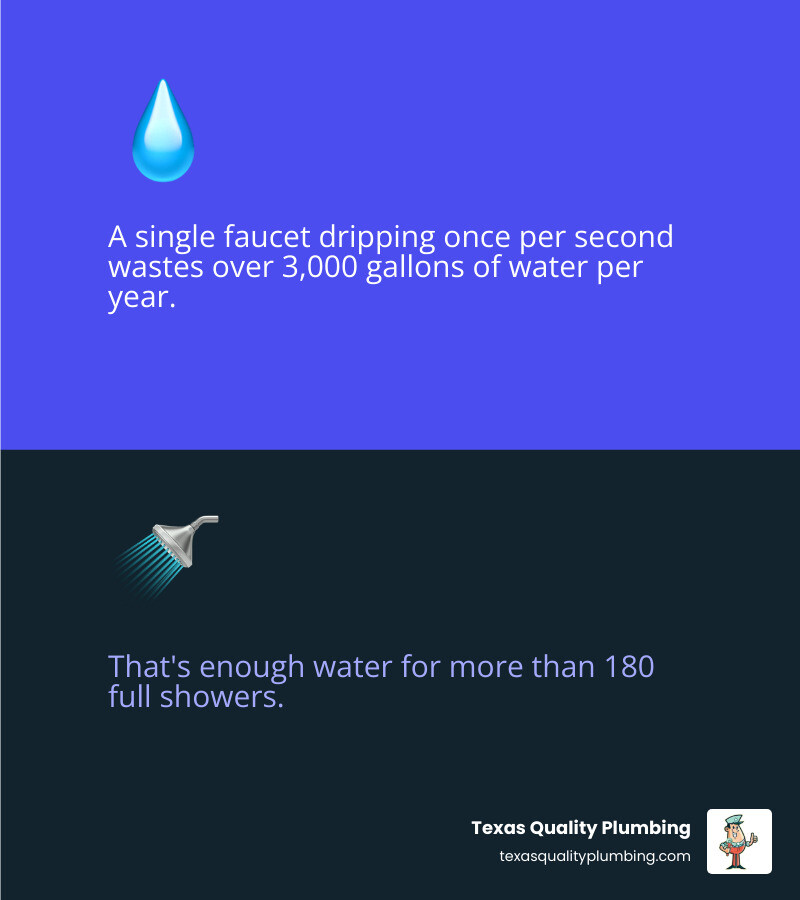
A single faucet dripping once per second wastes over 3,000 gallons of water per year — enough for more than 180 showers. That shows up on your water bill every single month. And in Houston, where hard water accelerates wear on internal faucet components, that drip can turn into something much better if left alone.
In the sections below, we’ll walk through every cause, show you how to identify where your specific leak is coming from, and explain when a DIY fix is enough — and when it’s time to call a licensed plumber.
Common Mechanical Culprits: Why Your Faucet Drips and What It Means for Your Plumbing
When we step into a home in Conroe or Cypress to investigate a leak, we usually find that the problem is mechanical. Faucets are the “end of the line” for your plumbing system, meaning they bear the brunt of daily use and water pressure. Over time, the internal components simply wear out.
The most frequent offender is the worn washer. In compression faucets, a rubber washer is pressed against a valve seat to stop the water flow. Every time you turn the handle, that washer experiences friction. Eventually, it thins out, cracks, or loses its shape, allowing water to squeeze past.
Another common issue is O-ring failure. O-rings are small rubber rings that seal the faucet handle. If you notice water puddling around the base of the handle every time you turn the faucet on, you likely have a 30% chance that a failed O-ring is the culprit.
Finally, we have corroded valve seats. The valve seat connects the faucet to the spout. In areas like Houston, mineral-rich water can cause sediment to build up on the seat, creating pits and jagged edges. Even if you put in a brand-new washer, it won’t be able to form a watertight seal against a corroded seat. To dive deeper into these specific fixes, check out these Conroe faucet repair tips.
Faucet Type Comparison Table
Understanding why your faucet drips and what it means for your plumbing often depends on the type of fixture you have.
| Faucet Type | Mechanism | Common Leak Source | Complexity |
|---|---|---|---|
| Compression | Rubber washers/Valve seats | Worn washers | Low |
| Cartridge | Plastic/Brass cartridge | O-rings or Cartridge | Medium |
| Ball | Rotating metal/plastic ball | Springs and Seals | High |
| Ceramic Disc | Two sliding ceramic discs | Sediment on discs | Low/Medium |
Understanding Why Your Faucet Drips and What It Means for Your Plumbing Internals
Modern faucets often use cartridges rather than simple washers. When a cartridge is damaged, it can cause the faucet to drip even when the handle is firmly in the “off” position. This is often caused by mineral buildup.
In the Greater Houston area, our water is notoriously hard. These minerals act like sandpaper inside your faucet, grinding down the smooth plastic or brass surfaces of the cartridge. If you are looking for faucet repair in Baytown, it is important to remember that replacing the entire cartridge is often more effective than trying to patch up individual seals.
Identifying the Source of the Leak
You can often diagnose the problem just by looking at where the water is escaping:
- Drip from the Spout: This usually points to a worn washer, a corroded valve seat, or a failing cartridge.
- Leak from the Handle: This almost always indicates a damaged O-ring or a loose packing nut.
- Moisture at the Base: If water is pooling where the faucet meets the sink, it could be a failing gasket or a leak in the supply lines underneath.
Learning how to handle leaky faucet repair in Baytown TX starts with this simple observation.
Beyond the Fixture: Systemic Issues and High Water Pressure
Sometimes, the faucet isn’t the problem—the water is. If you’ve replaced the parts and the drip persists, you might be dealing with high water pressure.

Standard residential plumbing is designed to handle pressure between 40 and 60 psi. Once your pressure exceeds 80 psi, it begins to stress every seal, joint, and valve in your home. High pressure can literally force water past a perfectly good washer. This is especially common in about 12% of homes and can lead to much bigger problems, like burst pipes or failing water heaters.
Another systemic cause is thermal expansion. When your water heater cycles on, the water inside expands. If your plumbing system is “closed” (meaning there is a check valve or pressure regulator), that expanding water has nowhere to go. It increases the pressure in the pipes, often resulting in a faucet that drips only when the water heater is running. If you suspect your system is under too much stress, it’s time to look into expert faucet repair services.
Why Your Faucet Drips and What It Means for Your Plumbing at Night
Do you notice that your faucet seems to drip more at night? You aren’t imagining it. This happens for two main reasons:
- Municipal Pressure Spikes: During the day, everyone in your Houston neighborhood is using water. At night, demand drops, causing the pressure in the city mains to spike. This extra force can push water through marginal seals that held fine during the day.
- Thermal Contraction: As temperatures drop at night, metal components in your faucet can shrink slightly. This tiny contraction can open up gaps in worn O-rings or washers, triggering a “ghost drip.”
Fixing these leaks in Champion Forest is often easier than you think once you understand these environmental factors.
The Hidden Risks of Ignoring a Leaky Tap
It is tempting to ignore a tiny drip, but “small” leaks lead to “big” bills. Beyond the 3,000 gallons of wasted water, a persistent leak creates a damp environment perfect for mold and mildew growth.
When a faucet leaks from the handle or the base, water often seeps into the vanity cabinet below. Over time, this causes cabinet rot and structural damage to your subflooring. We have seen beautiful hardwood floors ruined because a “minor” drip was ignored for too long. If you want to stop the water torture, immediate action is the only solution.
Impact on Houston Septic Systems
For our neighbors in more rural parts of the Greater Houston area who rely on septic systems, a dripping faucet is a serious threat. A septic tank depends on the soil’s ability to absorb water. A constant, 24/7 flow of water—even a drip—can saturate the drain field. This prevents the soil from drying out, eventually leading to catastrophic septic failure.
A single leaky fixture can add hundreds of gallons of unnecessary liquid to your tank every month, which is why professional faucet repair in Conroe is a vital part of septic maintenance.
DIY Repair Guide: Step-by-Step Instructions to Stop the Drip
If you’re ready to tackle the drip yourself, follow these steps.
Tools You’ll Need:
- Adjustable wrench
- Screwdrivers (Flathead and Phillips)
- Hex keys (Allen wrenches)
- Replacement parts (washers, O-rings, or cartridge)
- Plumber’s grease and white vinegar
The Process:
- Shut Off the Water: Locate the valves under the sink and turn them clockwise. Open the faucet to drain any remaining water.
- Cover the Drain: Use a towel or a stopper. You don’t want small screws disappearing down the pipes!
- Remove the Handle: You may need to pry off a decorative cap to reach the screw, or use a hex key for a set screw.
- Disassemble the Stem: Use your wrench to loosen the packing nut. Carefully pull out the cartridge or stem.
- Clean and Inspect: Use white vinegar to dissolve mineral deposits. Check the O-rings and washers for cracks.
- Replace and Reassemble: Install your new parts (use a bit of plumber’s grease on O-rings). Put everything back in the reverse order you took it apart.
For more detailed guides on specific areas, see our resources for Channelview faucet repair and Conroe kitchen and bathroom repair.
When to Choose Faucet Replacement in Bellaire TX
Sometimes, a repair isn’t enough. If your faucet is over 15 years old, or if the internal body is heavily pitted from corrosion, it is often more cost-effective to replace the whole unit. New faucets are more water-efficient and can save you money on your utility bills immediately. If you’re considering faucet replacement in Bellaire TX, we can help you select and install a fixture that will last for years to come.
Frequently Asked Questions About Faucet Leaks
How much money does a dripping faucet waste?
While water rates vary, a leak that wastes 3,000 to 10,000 gallons a year can noticeably increase your monthly bill. In some cases, fixing a leak can save a household about 10% on their annual water costs.
Why does my faucet drip only when I use the washing machine?
This is a classic sign of a water pressure issue. When the washing machine valve shuts off quickly, it creates a “water hammer” effect—a pressure surge that travels through your pipes and forces water out of the weakest point, which is often a faucet seal.
Can I use white vinegar to fix a leaky faucet?
Vinegar won’t fix a torn washer, but it is excellent for removing the mineral buildup that causes leaks in ceramic disc faucets and cartridges. Soaking your faucet parts in vinegar can restore the smooth surfaces needed for a proper seal.
Conclusion
At Texas Quality Plumbing, we know that a dripping faucet is more than just a nuisance—it’s a warning sign for your home. Whether it’s a simple worn washer or a systemic high-pressure issue, addressing the problem early prevents mold, structural damage, and wasted money.
We provide expert leak detection and faucet services across the Greater Houston area, from Pearland to The Woodlands and everywhere in between. Our licensed plumbers are ready to provide quick, efficient service to keep your home running smoothly. Don’t let your money go down the drain—contact us today to schedule your maintenance or repair!