

How a Dripping Faucet Wastes Hundreds of Gallons Per Year — And What It Means for Your Home
How a dripping faucet wastes hundreds of gallons per year is simpler to understand than most people expect — and the numbers are shocking once you see them.
Here’s a quick breakdown by drip rate:
| Drip Rate | Per Day | Per Month | Per Year |
|---|---|---|---|
| 1 drip/min | ~0.1 gal | ~3 gal | ~34 gal |
| 10 drips/min | ~1 gal | ~30 gal | ~365 gal |
| 60 drips/min | ~5 gal | ~150 gal | ~1,800 gal |
| 1 drip/sec (60/min) | ~17 gal | ~520 gal | ~3,000+ gal |
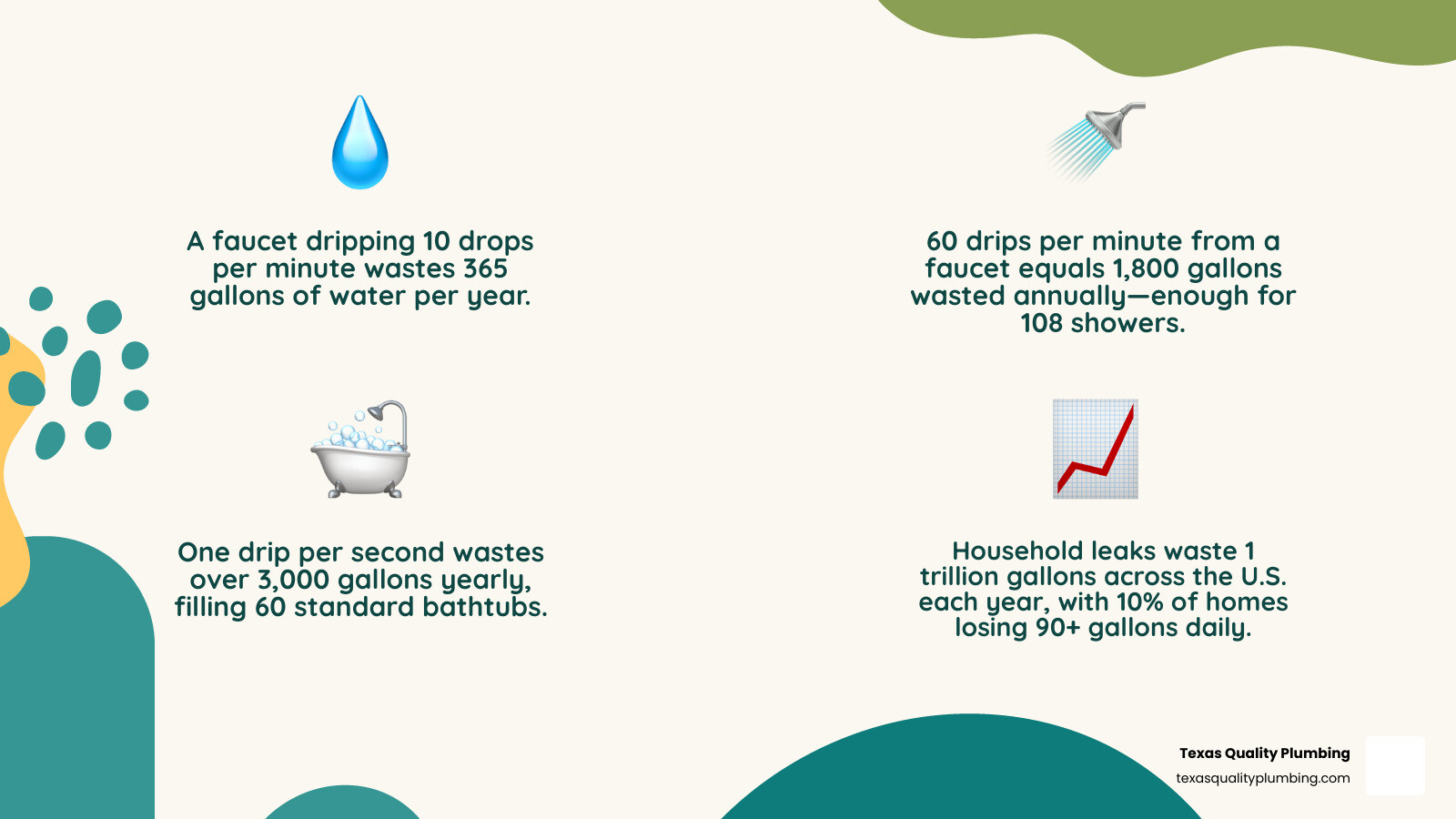
Even at just 10 drips per minute — a leak so slow you might not notice it — your faucet is quietly pouring roughly 365 gallons down the drain every year. At one drip per second, the EPA estimates that number climbs past 3,000 gallons annually. That’s enough water to supply about 180 showers or fill 60 standard bathtubs.
For Houston homeowners already juggling busy schedules, a slow drip is easy to ignore. But across the 10% of U.S. homes with leaks wasting 90 or more gallons per day, and with household leaks collectively burning through more than 1 trillion gallons of water nationwide each year, that quiet little “drip… drip… drip” is anything but harmless.
In this guide, we break down the real math behind faucet water waste, what causes leaks in Houston homes, how to spot and fix them, and when it’s time to call in a licensed plumber.
The Math Behind How a Dripping Faucet Wastes Hundreds of Gallons Per Year

When we talk about how a dripping faucet wastes hundreds of gallons per year, we are looking at a cumulative effect that catches most people off guard. A single drop of water seems insignificant—it’s roughly 0.25 milliliters. However, physics and time transform those tiny beads of water into a massive volume.
According to authoritative data from the USGS and the EPA, it takes approximately 15,140 drips to fill a single gallon. If your faucet is dripping just once per second, you are losing about 17 gallons of water every single day. Over the course of a year, that adds up to more than 3,000 gallons. To put that into perspective, that is enough water to run 180 showers or fill 60 standard bathtubs to the brim.
The scale of this waste is even more staggering when you look at it through the lens of a community. If 10,000 homes in the Houston area each had one faucet dripping at 60 drips per minute, the collective waste would be millions of gallons of treated, usable water simply vanishing into the sewer system.
Calculating How a Dripping Faucet Wastes Hundreds of Gallons Per Year
If you hear that rhythmic thumping in your sink, you don’t have to guess how much it’s costing you. You can calculate your specific waste using a few simple methods:
- The Stopwatch Method: Grab your phone and set a timer for 60 seconds. Count how many drips fall in that minute. Use the table in our introduction to see where your leak falls. If the drips are too fast to count, count for 15 seconds and multiply by four.
- The Measuring Cup Test: Place a kitchen measuring cup under the faucet for exactly 30 minutes. Take the amount collected and multiply it by 48 to find your daily waste. If you collect just half a cup in 30 minutes, you’re losing 24 cups (1.5 gallons) a day, or about 547 gallons a year.
- The USGS Drip Calculator: For those who want scientific precision, the USGS Water Science School provides interactive tools that allow you to input your drip rate and see the impact scaled across days, months, and years.
Why Ignoring How a Dripping Faucet Wastes Hundreds of Gallons Per Year Leads to Home Damage
A high water bill isn’t the only consequence of a leak. There are 4 Dangers Leaky Faucet issues that can compromise the integrity of your home.
- Structural Rot and Mold: Constant moisture in a cabinet or behind a backsplash creates a perfect breeding ground for mold and mildew. Over time, this moisture can rot the wood of your vanity or kitchen cabinets.
- Cabinet Warping: Even a “silent” leak that runs down the back of the faucet can cause expensive custom cabinetry to swell, warp, and eventually fall apart.
- Foundation Stress: In the Greater Houston area, our high clay soil content is sensitive to moisture. While a faucet drip usually goes down a drain, leaks near the base of a fixture or behind a wall can contribute to foundation shifting and cracks.
- High Interior Humidity: Persistent leaks increase the humidity inside your home, which can stress your AC system and even trigger allergies or respiratory issues for sensitive family members.
Common Causes of Faucet Leaks in Houston Homes
Understanding why your faucet is dripping is the first step toward stopping the waste. In our experience serving areas from The Woodlands to Sugar Land, several common culprits emerge:
- Worn-out Washers and O-rings: These are the most common mechanical failures. Every time you turn the handle, these rubber or silicone parts compress to create a seal. Over years of use, they become brittle, cracked, or flattened.
- Corroded Valve Seats: The valve seat connects the faucet and the spout. If minerals from our water build up here, it can cause corrosion, allowing water to seep through even when the handle is tightly closed.
- High Water Pressure: If your home’s water pressure is above 60–80 PSI, it puts a constant strain on every seal in your plumbing system. This can force water past gaskets that would otherwise be perfectly fine.
- Houston Hard Water: Our local water often carries a high mineral content. These minerals accumulate inside your fixtures as scale, which can act like sandpaper on the internal components of your faucet.
If you are dealing with these issues, you might find some relief by following these Stop the Drip with These Conroe Faucet Repair Tips.
DIY Troubleshooting and When to Call a Professional
Many homeowners attempt a DIY fix to stop the drip. If you have a basic compression faucet, you may be able to replace a washer or an O-ring yourself.
- Step 1: Shut off the water: Always locate the shut-off valves under the sink before you start. If they are stuck or brittle, do not force them; this is a sign you need professional help.
- Step 2: Identify the faucet type: Modern homes often use cartridge or ceramic disc faucets, which are more complex than old-fashioned compression models.
- Step 3: Disassemble carefully: Take photos as you go so you know exactly how the internal parts fit back together.
If you’re feeling confident, you can learn How to Handle Leaky Faucet Repair in Baytown, TX Like a Pro. However, if the drip persists after you’ve replaced the parts, or if you notice water spraying from the base, it’s time to look into Fix Your Leaky Faucet Today: Expert Faucet Repair Services.
Professional Solutions for Persistent Drips
Sometimes a “simple” drip is a symptom of a much larger problem. When we visit a home for The Ultimate Guide to Leaky Faucet Repair in Channelview, TX, we don’t just look at the spout.
Professional plumbers use specialized tools like electronic leak detection to ensure there isn’t a hidden pipe crack behind the wall. We can also install pressure regulators to protect your fixtures from the high-pressure surges common in municipal water lines. If your valve seat is corroded, we have the tools to resurface it, extending the life of your fixture without needing a full replacement. You’ll find that Leaky Faucet Repair in Champion Forest, TX is Easier Than You Think when you have the right expertise on your side.
Long-Term Prevention Strategies
To keep your faucets from failing prematurely, consider these maintenance tips:
- Install a Water Softener: This is the best defense against mineral buildup in Houston. By removing the “hardness,” you protect the delicate internal seals of your high-end fixtures.
- Routine Inspections: Once a year, check under every sink for moisture. Use the “paper towel test”—place a dry paper towel under the trap and check it the next morning for dampness.
- Gentle Operation: Don’t crank the handles. Overtightening a faucet to stop a drip actually grinds the washer against the seat, making the leak worse in the long run.
- Clean Aerators: Regularly soak your faucet aerators in vinegar to remove scale. This ensures proper flow and prevents back-pressure that can cause leaks.
You can Stop the Water Torture with Bellaire Leaky Faucet Repair by being proactive with these simple steps.
Frequently Asked Questions
How much more water does a leaky showerhead waste compared to a faucet?
A leaky showerhead can be significantly more wasteful than a kitchen faucet because the flow rates are generally higher. While a faucet dripping once per second wastes 3,000 gallons a year, a showerhead leaking at just 10 drips per minute can waste over 500 gallons annually. If that showerhead has a steady stream or a faster drip rate of 120 drips per minute, it can waste as much as 11 gallons per day—enough to run 60 dishwasher cycles in a single year.
Can a dripping faucet affect my energy bill?
Yes, if the leak is on the hot water side. When a hot water faucet drips, your water heater has to constantly work to heat the fresh water that enters the tank to replace what was lost. This creates a “thermal loss” that keeps your heater running more often than necessary, driving up your gas or electric bills in addition to your water bill.
What are the signs of a hidden leak if I don’t see a drip?
Not all leaks are visible. In Houston, our shifting clay soil can cause underground pipes to crack. Signs of a hidden leak include:
- Water Meter Test: Turn off all water in the house and check your meter. If the dial is still moving, you have a leak.
- Food Coloring Test: Put a few drops of food coloring in your toilet tank. If the color appears in the bowl without flushing, you have a silent leak wasting hundreds of gallons.
- Damp Spots: Unexplained wet spots in your yard or warm spots on your floor (which could indicate a slab leak).
- Low Water Pressure: A sudden drop in pressure often means water is being diverted through a major break elsewhere in the system.
Conclusion
At Texas Quality Plumbing, we know that a dripping faucet is more than just an annoying sound—it’s a drain on your finances and our local resources. Whether you are in Houston, Cypress, Katy, or Pearland, our team is ready to help you stop the waste. We provide expert leak detection, professional repairs, and routine maintenance to keep your home running efficiently.
Don’t let a tiny drip turn into a massive headache. Our licensed plumbers offer quick, efficient service with guaranteed 24-hour appointments. If you’re ready to save water and protect your home, Fix Your Leaky Faucet Today: Expert Faucet Repair Services by calling us or scheduling an appointment online. We are here to ensure your plumbing stays “Texas Quality” all year long!